
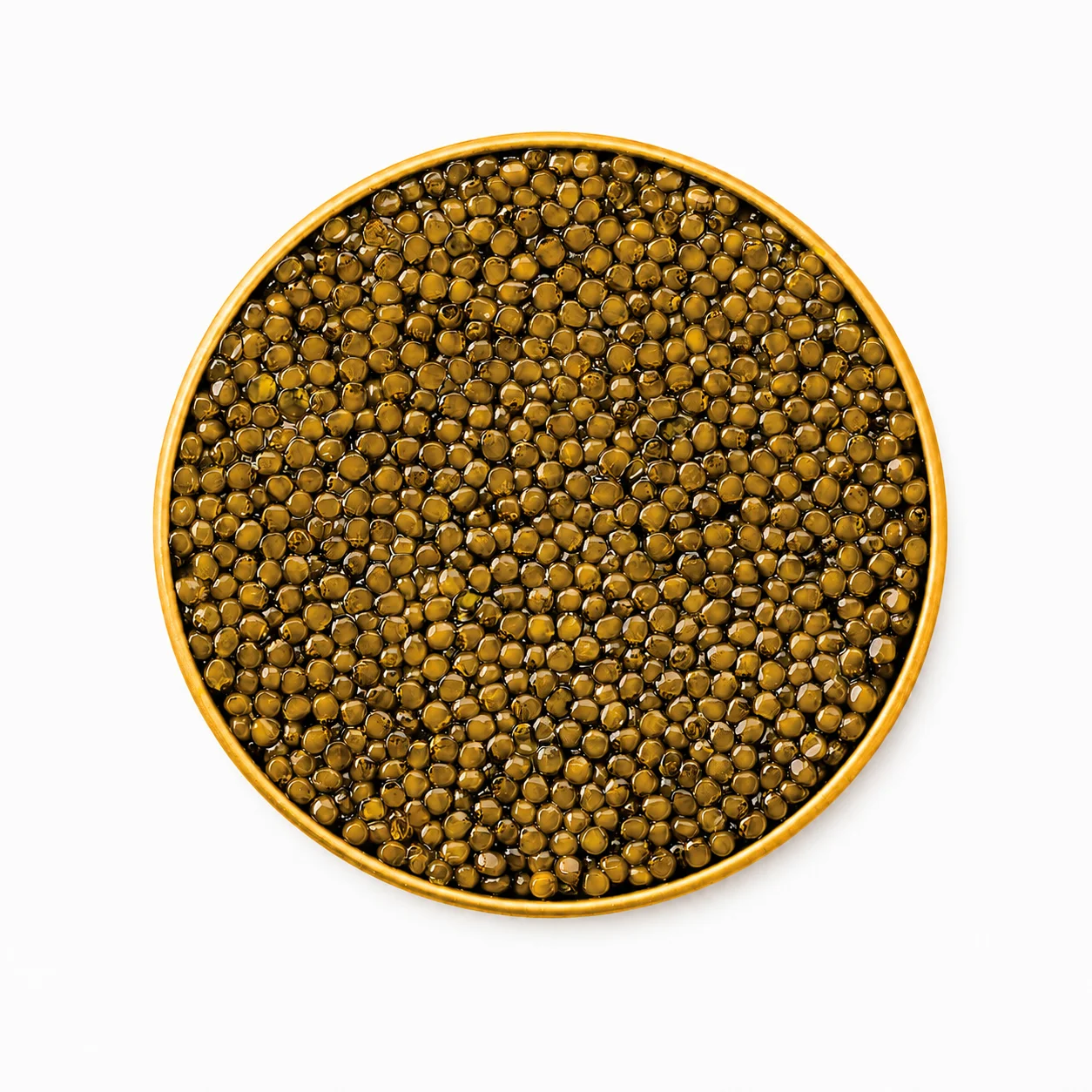
Caviar Beluga 000 | Huso Huso Sturgeon
Matrice pure : Élaboration stricte au sel (méthode Malossol), sans conservateur de synthèse. Préservation intégrale de la structure cellulaire du grain.
Matières Premières et Variables de Production
Espèce et Traçabilité
Issu exclusivement de l’esturgeon Huso huso. Traçabilité garantie par certification CITES, assurant l’origine géographique et le respect strict des réglementations sur la protection de l’espèce.
Méthode de Salage
Stabilisation par la méthode traditionnelle Malossol (faible teneur en sel). Ce procédé osmotique précis permet de conserver l’intégrité de la membrane sans dénaturer le profil aromatique naturel des lipides.
Données Techniques et Maturation
Calibrage des Grains
L’indice « 000 » est le standard de mesure indiquant le diamètre le plus important pour cette espèce (généralement supérieur à 3,5 mm). Les œufs de cette catégorie se distinguent par une membrane extrêmement fine et fragile, nécessitant une manipulation manuelle rigoureuse.
Disponibilité et Rendement
Volume d’extraction annuel strictement limité, corrélé à la maturité biologique très tardive de l’espèce Huso huso.
Caractéristiques Organoleptiques
-
Cinétique en boucheRupture franche et nette de la membrane sous une faible pression mécanique. La dissolution est immédiate, libérant une matrice dense et veloutée.
-
Spectre AromatiqueDominante d’amande douce et de beurre frais, soutenue par une salinité très faible. La persistance gustative est longue, dénuée d’amertume ou d’oxydation métallique.
-
Profil VisuelGrains sphériques et lisses. Le spectre chromatique évolue naturellement du gris souris vers le gris clair et le doré. Une teinte plus claire est l’indicateur direct de l’âge avancé de l’esturgeon.
Paramètres d’Utilisation et Conservation
01
Application Culinaire : Utilisation stricte à cru. L’emploi d’ustensiles en nacre, corne ou bois est impératif ; le contact avec des métaux non inertes catalyse l’oxydation des lipides cellulaires et altère le spectre aromatique.
02
Dosage : Format de 50 g calibré pour une analyse sensorielle précise ou une intégration au gramme sur une base neutre.
03
Storage: Stabilité biologique conditionnée par un maintien strict de la chaîne du froid, entre 0 °C et 3 °C. Durée de conservation de 3 à 4 mois en boîte scellée. Post-ouverture, l’exposition à l’oxygène accélère l’oxydation membranaire : consommation requise dans un délai de 48 à 72 heures.
Reviews
There are no reviews yet.