
By the Artdeluxe Paris editorial team. Updated October 31, 2026.
Yemen coffee is arabica grown on the terraced highlands of western Yemen, mostly sun-dried as whole cherries. Known for winey, spicy and deep chocolate flavours, it is among the world’s oldest cultivated coffees. Output is tiny and origin fraud is a real concern, so traceability matters as much as taste.
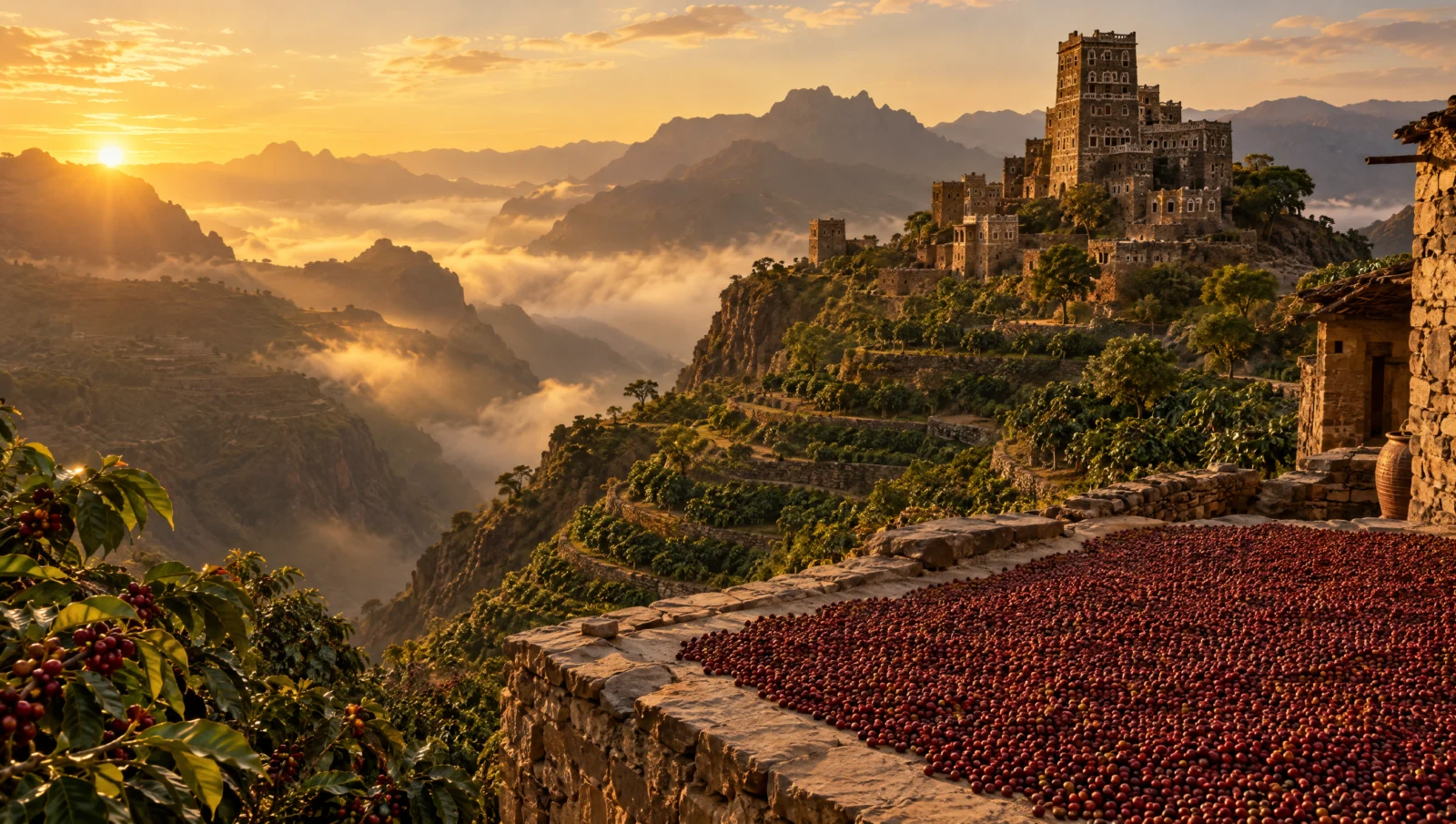
What is Yemen coffee?
Yemen coffee is any coffee grown in Yemen, almost always arabica from old local plant lines. Yemen was the first country to cultivate coffee commercially. Today its production is very small: the FAO estimated about 20,800 tonnes in 2019, grown on around 35,000 hectares.
Coffee itself came from Ethiopia. World Coffee Research places its arrival across the Red Sea in the mid-fifteenth century. It became a farmed crop in Yemen, and from the eighteenth century Yemeni plants spread around the world along European trade routes. Genetic research has confirmed that nearly all arabica grown outside Ethiopia descends from those early Yemeni farms.
What do Mokha, Matari and Haraaz mean?
Mokha is a Red Sea port, while Matari and Haraaz are growing areas. Mokha on a label usually signals Yemeni heritage rather than a farm. Matari points to Bani Mater and Haraaz to the mountains of the same name. None of these names proves origin on its own.
Mokha, also written Mocha, gave its name to the coffee shipped through it for centuries. The chocolate drink called a mocha borrowed the word much later and has nothing to do with this origin.
| Name | What it is | What to remember |
|---|---|---|
| Mokha (Mocha) | Historic port on the Red Sea | A trade name, not a growing region |
| Bani Mater (Matari) | Growing region | Roasters generally report about 1,800 to 2,400 m. Matari is not a strict zone, and the name can be stretched to other coffees |
| Haraaz | Growing region | Among the most prized, with centuries-old terraces and water systems |
| Bani Hammad, Bura’a, Haimateen | Growing regions | Rarer on export labels |
| Tuffahi, Dawairi, Udaini | Local cultivars | Tuffahi: mild and sweet. Dawairi: winey, deep fruit. Udaini: earthy, thick body |
These cultivar names deserve some caution: Royal Coffee notes that these local types are not always genetically distinct, and they are often grouped as “heirloom”.
How is Yemeni coffee grown and processed?
Yemeni coffee grows mostly on mountain terraces, in dry conditions where water is scarce. Natural processing dominates: whole cherries dry for several weeks, often on flat stone rooftops, before hulling. This method needs little water and gives the fruit-driven, winey character that sets Yemeni coffee apart.
Scarcity shapes everything here. Coffee competes for water with qat, a stimulant crop that is a steady source of income for many farmers. The harvest generally runs from October to February. Lots are so small that filling a shipping container is difficult, so much specialty coffee from Yemen travels by air.
What does Yemen coffee taste like?
Yemen coffee usually tastes winey, spicy and deep, with dried fruit and dark chocolate notes and a heavy body. The FAO describes deep chocolate tones lifted by a winey character from natural processing. Expect a complex, rustic cup rather than a clean, bright one.
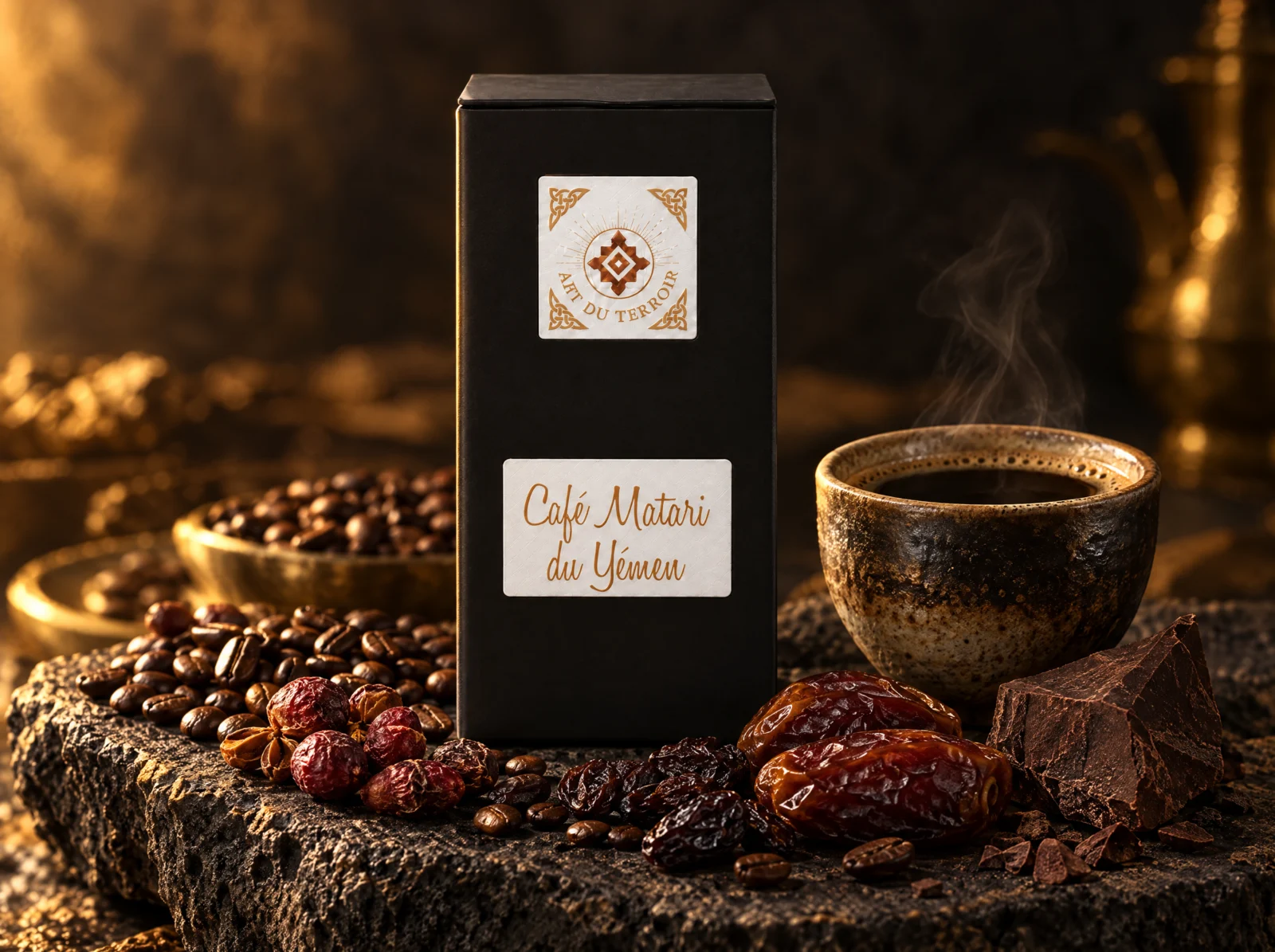
Our Matari leans toward raisins, dates, spice and bitter cocoa, with a dense, syrupy body.
Why is Yemeni coffee so expensive?
Yemeni coffee is expensive because supply is small and every step costs more. Steep terraces rule out mechanisation, water is scarce, and conflict has raised the cost of moving coffee to market. Air freight, low volumes and strong demand from Saudi Arabia then keep prices well above most other origins.
The FAO reports that the conflict has severely increased costs along the whole chain. Royal Coffee adds that even lower grades trade at remarkable premiums.
| Type of coffee | Price per kg |
|---|---|
| Mainstream Yemeni coffee, sold online in the US | about $80 to $100 |
| Bani Matar specialty lot, US | about $270 |
Prices read online on October 31, 2026, shipping excluded.
How can you tell if Yemeni coffee is real?
To check Yemeni coffee, ask who grew it, in which region, and in which harvest year. Genuine sellers can usually name a region or cooperative and show export paperwork. Be wary of a low price, a vague “Mocha” label, or a blend that gives no percentage of Yemeni coffee.
Fraud is a documented concern. A 2024 study in Scientific Reports estimates that as much as 50% of coffee sold as Yemeni may in fact be African coffee re-exported under a Yemeni label. Its authors include a Yemeni coffee trader, so read the figure as an industry estimate. The same study shows that near-infrared testing can separate Yemeni beans from other origins.
Before buying, check four things:
- Region: a named area such as Bani Mater or Haraaz, not only “Yemen” or “Mocha”.
- Harvest: a stated crop year.
- Process: natural is the norm, so any other process should be explained.
- Share of Yemeni coffee: 100%, or a stated percentage in a blend.
How should you brew Yemen coffee?
Brew Yemen coffee with water at 93 to 95 °C, using a French press or espresso to bring out its body. A good starting ratio is 15 g of coffee for 250 ml of water, with a 30-second bloom. Grind just before brewing, then adjust to your taste.
To compare with very different cups, try the Bourbon Pointu from New Caledonia, light and floral, the Saint Helena coffee, silky, or the Bonifieur from Guadeloupe, aged.
Discover our Yemen Matari coffee.
Frequently asked questions
Is Yemen the birthplace of coffee?
Not quite. Arabica originated in Ethiopia. Yemen is where it was first cultivated commercially, and the place from which it spread to the rest of the world.
Is Yemeni coffee the same as a mocha?
No. Mokha is the Yemeni port that shipped the coffee. The mocha sold in cafés is an espresso drink with chocolate.
Is Matari better than Haraaz?
Neither is better by name alone. Both are respected growing regions, and quality depends on the lot, the drying and the harvest year.
What is qishr?
Qishr is a Yemeni product made from coffee husks rather than the beans. The FAO reports about 1,200 tonnes exported in 2019.
When is the best time to buy Yemeni coffee?
The harvest runs from October to February and export timing varies widely, so a stated crop year is more useful than the season.
Sources
- World Coffee Research, Yemeni coffee: how genetically diverse is it?, December 2021.
- Scalabrin et al., A single polyploidization event at the origin of the tetraploid genome of Coffea arabica, Scientific Reports, 2020.
- FAO, Coffee value chain in Yemen.
- Royal Coffee, Yemen Green Coffee Export Review, June 24, 2026.
- Sweet Maria’s, Yemen Coffee Overview.
- Inheritance Coffee, Bani Matar ; Green Bean Roasters, Bani Matar.
- Santos-Rivera, Montagnon and Sheibani, Identifying the origin of Yemeni green coffee beans using near infrared spectroscopy, Scientific Reports, 2024.