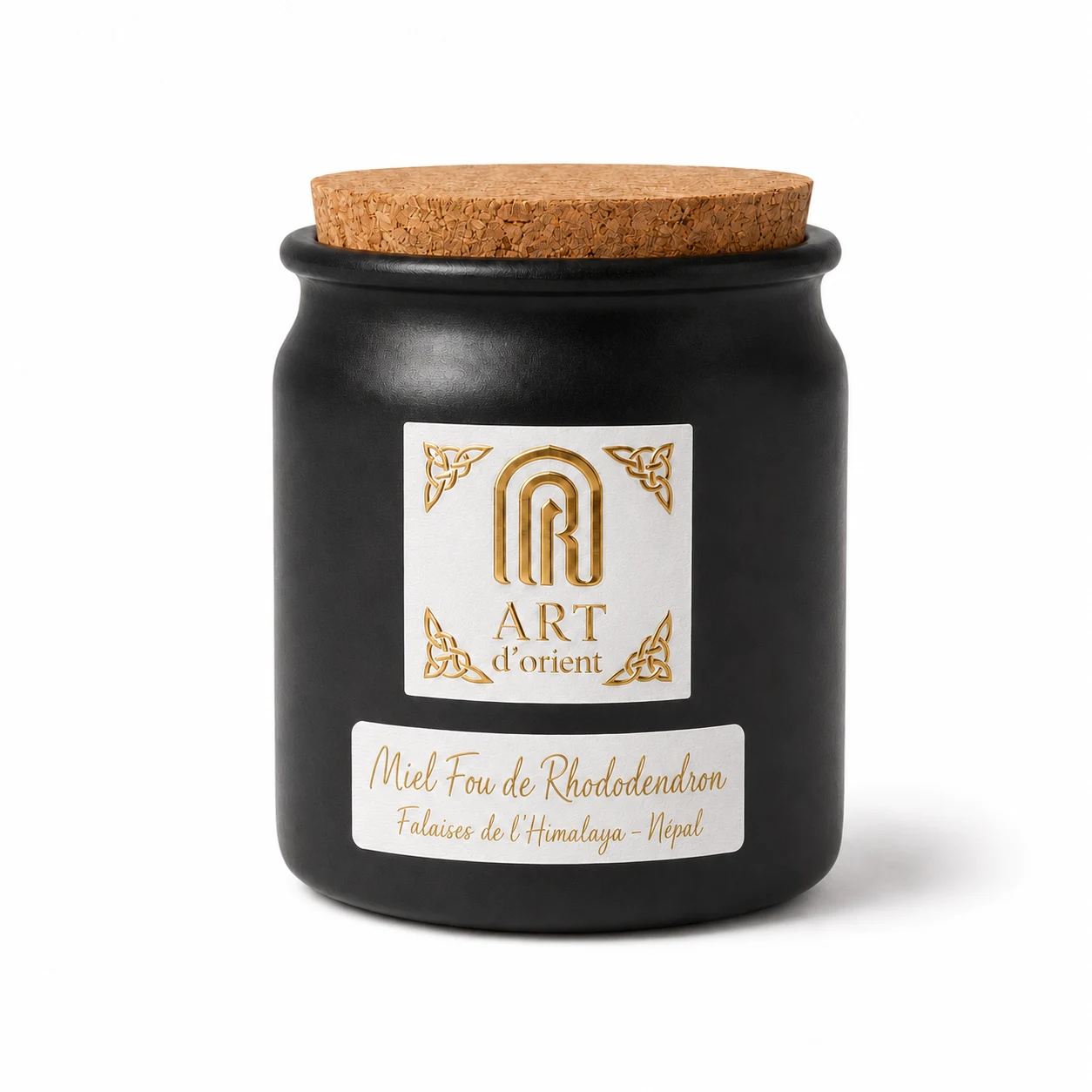
Rhododendron Honey from Nepal | Rare Grade • Grayanotoxin Content
Active molecular structure: a mono-floral honey from the nectar of Rhododendron anthopogon and Rhododendron arboreum, characterised by the presence of diterpenes.
Location and Growing Variables
Biotope
Harvested in the high-altitude regions of the Nepalese Himalayas, between 2,500 and 4,000 metres. Rhododendron shrubs, endemic to these steep zones, are the principal source of nectar during the spring flowering.
Prélèvement
Harvested by local communities on sheer cliff faces. The honey is gathered from swarms of giant bees (Apis dorsata laboriosa), the only species able to forage at such altitudes and to produce this singular honey from rhododendron blossom.
Technical Data and Processing
Naturally occurring grayanotoxins (types I and III). These molecules are secondary metabolites of the plant, transferred into the honey. Their presence is what distinguishes this honey, which is traditionally consumed in very small quantities.
Raw honey, cold-extracted and not industrially filtered. This process preserves the entirety of the pollen particles and enzymes, and the natural stability of its active compounds.
An amber hue with reddish reflections. Viscosity is high, with a reduced water content owing to the dry high-altitude climate, which prevents any spontaneous fermentation.
Caractéristiques Organoleptiques
-
Cinétique en boucheA gentle attack followed by a characteristic bitterness and a slight tingling or numbing sensation on the oral mucosa — the signature of the plant compounds naturally present.
-
Spectre AromatiqueA complex profile dominated by floral and herbaceous top notes. The heart reveals woody nuances and a persistent herbal bitterness on the finish.
-
Impact PhysiologiqueGrayanotoxins are the compounds responsible for this honey's singular reputation. Their effects vary considerably from one individual to another, which is why consumption must be strictly limited to very small quantities.
Parameters of Use and Storage
Administration : Consumption must be strictly limited to a dose of 5 g to 10 g (one teaspoon) per 24-hour period. Exceeding tolerance thresholds may cause bradycardia or impaired coordination.
Protocol: Best enjoyed pure, without dilution in hot liquids, so as not to alter the structure of the diterpenes.
Storage: Store in an opaque glass jar, away from light and heat. The stability of the active compounds is maintained by storage at a constant room temperature (15°C to 22°C).